
Peshawari Chapli Kabab

Food Fusion
Chef
“Asad Memon and Saima Asad are the founders of Food Fusion, Pakistan’s leading digital food channel. They revolutionized home cooking with short, high-quality, and easy-to-follow video recipes for global audiences.”

Aarif
Food Journalist
Aarif is a devoted content writer at Regional Heritage Food (RHF), passionate about cooking and travel. He shares his culinary experiences and discoveries, inspiring others to explore new recipes and flavors.
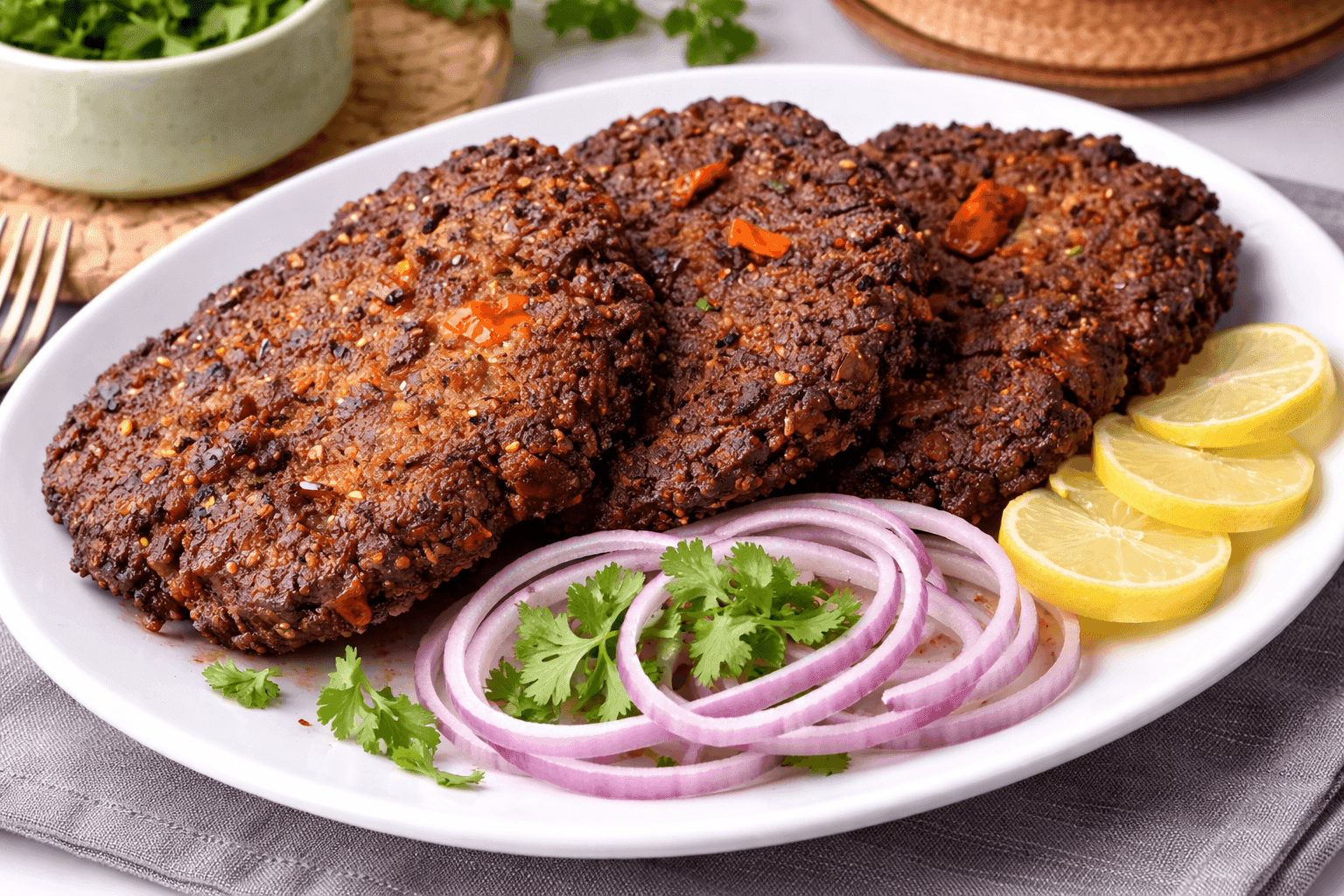
Coarse-Ground Beef, Pomegranate Seeds & the Open Flame | The Original KPK Street Kabab Made at Home.
Chapli kabab belongs to Khyber Pakhtunkhwa the way biryani belongs to Karachi. It is the food the province is most proud of and most protective of. Every dhaba cook in Peshawar, Mardan, and Nowshera has a version they claim is the original, and every version has the same four things in common: beef mince with serious fat content, dried pomegranate seeds for tartness, maize flour for the crust, and a pan of rendered beef fat for frying. Everything else is regional variation. These four things are the non-negotiable foundation.
Food Fusion's chapli kabab recipe is a recipe that reveals the secrets most home versions skip: why the onions must be squeezed completely dry, why the tomatoes go in last, why the fat ratio in the mince is the most important ingredient decision in the recipe, and why rendering real beef fat for frying is what turns a good kabab into the one you remember.
Why This Recipe Works Better Than Others
30% Fat Mince Keeps the Center Juicy
Lean mince produces a firm, dry kabab no matter how carefully everything else is done. Fat is not a problem in this recipe. At 30% fat content, the mince stays juicy during frying because the fat renders slowly from within as the crust forms. Ask your butcher specifically for 30% fat or ask them to add fat trimmings to regular mince.
Completely Dry Onions Stop the Kabab Falling Apart
Onions carry a large amount of water. Unsqueezed onions release that water during frying, causing the kabab to steam from the inside and break apart in the oil. Chop the onions finely, wrap in a cloth, and squeeze repeatedly until no more liquid comes out. They should feel almost dry and papery before going into the mixture.
Maize Flour Creates the Signature Crust
Maize flour does two things: it absorbs residual moisture in the mixture so the kabab holds its shape, and it produces a distinctly crispy, slightly coarse crust when it contacts hot fat. Wheat flour makes a soft crust. Gram flour makes a dense one. Maize flour makes the real chapli kabab crust and cannot be substituted.
Beef Fat Delivers the Dhaba Flavour
Roadside dhabas in Peshawar fry every kabab in rendered beef fat, not cooking oil. Beef fat has a higher smoke point and imparts a deep, rich flavour into the crust that cooking oil simply does not produce. If you can get charbi from a butcher, use it.
A Cooked Omelet Inside Creates a Tender Center
A cooked omelet chopped into small pieces and folded into the mixture just before frying creates soft pockets of texture inside the kabab. When you bite through the crust, those pockets give the interior a looseness and juiciness that contrasts with the firm outside. It also binds the mixture from within without adding moisture, which is why it works differently from adding a raw egg directly.
prep time
20 min
RESTING TIME
2h
cook time
20 min
kababs
8
Ingredients
 Beef mince500 g
30% fat content specifically
 Onions3 piece
medium, finely chopped and squeezed completely dry before use
 Green chillies12 pieces
chopped
 Tomatoes2 pieces
 Eggs3 pieces
2 for the omelet, 1 added directly to the mixture
Method
MAKE THE OMELET
Heat 2 tsp of cooking oil in a small frying pan on medium flame.
Whisk 2 eggs lightly in a bowl with a pinch of salt. Pour into the pan and spread into a flat, even layer.
Cook for 1 to 2 minutes until the bottom is set, then flip once and cook the other side for another minute until fully cooked through with no wet egg remaining.
Remove from the pan and set aside to cool completely. Once completely cold, chop the omelet into small rough pieces, roughly half a centimeter each.
Do not make them too fine. The small pieces should be distinct enough to create pockets of soft texture inside the finished kabab.
Chef's Tip:
Cool the omelet completely before chopping and adding to the mixture. A warm omelet added to cold mince begins to warm the fat in the mince, making the mixture soft and sticky and harder to shape cleanly. The omelet can be made well ahead of time and refrigerated until needed. Preparing it the evening before and keeping it in the fridge overnight is perfectly fine.
SQUEEZE THE ONIONS COMPLETELY DRY
Add the 3 medium onions to a food chopper and chop finely. Do not blend into a paste. The onion pieces should be small and uniform but still have some texture.
Transfer the chopped onion to the center of a clean kitchen cloth or several layers of paper towels. Gather the edges up into a bundle and squeeze with both hands over the sink, firmly and repeatedly, until no more liquid comes out.
The onion should feel noticeably dry and the cloth should have absorbed a significant amount of water. This step is not optional and it cannot be done partially. Onions that still feel damp when you release the cloth will release their remaining moisture into the hot oil and cause the kababs to fall apart.
Chef's Tip:
Squeeze in batches if the full quantity of onion is too much to hold in one cloth. The total amount of liquid that comes out of three medium onions is substantial and will surprise you the first time you do this properly. That liquid is exactly what breaks chapli kababs apart in the pan. Getting it all out before the onion touches the mince is the single most impactful technique in this recipe
BUILD THE KABAB MIXTURE
In a large mixing bowl, combine the beef mince and the squeezed onions.
Add the finely chopped green chillies, ginger garlic paste, and fresh coriander.
Now add all the spices: crushed anardana, crushed coriander seeds, crushed red chilli, cumin powder, salt, garam masala, crushed carom seeds, and black pepper.
Use your hands to mix everything thoroughly until the spices are fully and evenly distributed through the mince with no patches of unmixed spice visible.
Add 1 egg and mix well. Finally add 1 cup of maize flour and mix again until the flour is fully incorporated throughout the mixture.
Chef's Tip:
Mix with your hands, not a spoon. Your hands can feel whether the spices are evenly distributed and whether the maize flour has been worked into every part of the mixture. A spoon mixes the surface but leaves pockets of unmixed mince inside the bowl. Two to three minutes of thorough hand mixing ensures the mixture is completely uniform. Keep your hands cold by rinsing with cold water before mixing if the mixture starts feeling warm and sticky
FIRST REST IN THE REFRIGERATOR
Cover the bowl tightly with cling wrap and place in the refrigerator.
Minimum resting time is 1 hour. Ideally rest overnight for up to 24 hours. Do not add the tomatoes or the omelet at this stage.
The first rest serves two purposes. The maize flour hydrates and swells slightly, improving its binding ability significantly. The spices penetrate deeper into the meat fibres, producing a more fully seasoned kabab rather than one where the spice sits on the surface.
A mixture rested overnight produces noticeably better flavour than one rested for just one hour, which is why Food Fusion specifically mentions this as an option in the original recipe.
Chef's Tip:
Label the bowl with the time it went into the fridge if you are making this the night before. It is easy to lose track and end up with a mixture that has rested for 30 hours rather than 12, which is still fine but worth knowing. The mixture can be refrigerated for up to 24 hours safely. Beyond that, the quality of the mince begins to decline regardless of the cold
ADD TOMATOES AND OMELET BEFORE FRYING
Remove the rested mixture from the refrigerator.
Add the deseeded and roughly chopped fresh tomatoes and all the chopped cooked omelet pieces.
Fold everything together gently using your hands, using a folding motion rather than aggressive mixing. You want the tomatoes and egg pieces distributed through the mixture without mashing or breaking them.
Once combined, cover the bowl again and return to the refrigerator for a final 30 minutes before shaping and frying.
Chef's Tip:
Deseeding the tomatoes is not optional even at this late stage. The seeds and surrounding gel hold most of the tomato's water. A deseeded tomato piece adds freshness, slight acidity, and a juicy burst when you bite into the kabab. A seeded tomato piece adds all of that plus enough extra water to make the shaped kabab soft at the edges and prone to breaking in the oil. Cut the tomatoes in half, scoop out the seed cavity with a spoon, and use only the firm flesh
RENDER THE BEEF FAT
Place 500g of beef charbi (raw beef fat) into a heavy frying pan over low heat. Cover with a lid for the first 5 minutes to help the rendering begin.
Then remove the lid and cook on low flame, stirring occasionally, for 15 to 20 minutes until all the fat has melted into a clear amber liquid and the remaining solid pieces are dry, shrunken, and golden.
Remove and discard the solid pieces. What remains in the pan is rendered beef fat ready for frying. Keep on the lowest flame to maintain temperature while you shape the kababs.
Chef's Tip:
Render on low heat throughout. High heat causes the fat to burn and produce a sharp, acrid flavour that transfers into the kabab crust. Low and slow renders the fat cleanly into a pure, clear liquid with a mild, rich beef aroma. If the rendered fat starts smoking at any point, remove the pan from the heat immediately and allow it to cool for two minutes before returning to the flame. Smoking fat is too hot and will burn the outside of the kababs before the interior is cooked.
SHAPE THE KABABS WITH COLD WET HANDS
Fill a bowl with ice-cold water and have it ready beside your work surface.
Dip both hands into the ice water, shake off the excess, then lightly coat your palms with a small amount of oil.
Take approximately 150 grams of mixture per kabab, roughly a generous heaped handful.
Press the mixture between both palms and flatten it into a round disc approximately 1 centimeter thick and 10 to 12 centimeters in diameter. The edges should be smooth and even all the way around.
Place the shaped kabab on a clean flat tray. Repeat with the remaining mixture, dipping hands back into the ice water between each kabab.
Chef's Tip:
Cold hands are essential and they become more essential as you work through the batch. The fat in the mince softens quickly when it contacts warm hands, making the mixture sticky, difficult to shape cleanly, and prone to collapsing in the oil because the fat is already partially softened before frying begins. Cold hands keep the fat in the mixture solid throughout shaping. If your kitchen is warm, keep the shaped kababs on the tray in the refrigerator while you finish the rest of the batch.
FRY ON MEDIUM-LOW HEAT
Bring the rendered beef fat back to medium-low heat. Carefully lower the shaped kababs into the fat using a wide flat spatula.
Do not crowd the pan. Fry two to three kababs at a time depending on pan size, leaving enough space between each one to allow even heat distribution.
Cook on medium-low heat for 4 to 5 minutes without touching or moving the kababs.
The kabab will release naturally from the pan surface when the bottom crust is fully set and golden.
Flip gently with a wide spatula and cook the second side for another 4 to 5 minutes to the same deep golden colour. Drain briefly on paper towels and serve immediately.
Chef's Tip:
Medium-low heat is not a preference. It is a requirement for a kabab that is this thick and this dense. The interior of a 150g chapli kabab needs time to cook through completely, and the only way to give it that time without burning the outside is to keep the flame lower than feels instinctive. A kabab that looks perfectly golden on the outside but is still pink inside is the result of frying on high heat. Keep the flame steady at medium-low for the full 4 to 5 minutes per side and the inside will be fully cooked when the outside is the right colour.
Master Tip: The Two-Stage Addition Method
Food Fusion's testing process revealed one timing rule that most chapli kabab recipes never mention: not all ingredients go into the mixture at the same time. The base mixture of mince, squeezed onions, spices, and maize flour is made first and rested in the refrigerator for at least an hour, ideally overnight.
The tomatoes and the chopped cooked omelet are only added in the final stage, 30 minutes before frying. The reason is straightforward. Tomatoes release water when they sit in a mixture for any length of time. If they go into the base mixture and rest overnight with everything else, by the next morning the entire mixture has absorbed that water and become too wet to shape cleanly.
Adding them at the last possible moment means they contribute freshness and a slight juiciness to the finished kabab without compromising the structure. The same applies to the omelet. It holds its shape and creates distinct soft pockets inside the kabab only when added at the end. Added to the base mixture and rested, the egg pieces blend into the mince and lose their distinct texture entirely
Nutritions
Per Kabab (~150g)
People Also Ask
There are three causes and usually more than one is present at the same time. First, the onions were not squeezed dry enough and released their water into the hot oil, causing the kabab to steam and lose structure. Second, the tomatoes were added too early and sat in the mixture long enough to release their moisture. Third, not enough maize flour was used to bind the mixture. The fixes are straightforward: squeeze the onions until the cloth is genuinely dry, add tomatoes only in the final 30 minutes before frying, measure the maize flour accurately at 1 cup per 500g of mince, and rest the shaped kababs in the refrigerator for 15 minutes before frying.
Anardana is dried pomegranate seeds, widely available at Pakistani and Indian grocery stores. It is the ingredient that gives Peshawari chapli kabab its distinctive tangy, slightly fruity depth that no other spice in the mixture provides. If completely unavailable, a small squeeze of pomegranate molasses or half a teaspoon of amchur (dried mango powder) can approximate the tartness it adds, but the flavour will not be identical. Source the real thing if at all possible. Buy whole dried seeds and crush them coarsely yourself rather than using pre-ground anardana powder, which loses its flavour quickly after grinding.
Yes. A neutral cooking oil like sunflower or canola oil works perfectly well as a substitute and the kababs will hold their shape and develop a good golden crust. The difference is in the flavour of that crust. Rendered beef charbi has a distinct richness and slight smokiness that it imparts to the surface of the kabab during frying, which is the reason every Peshawar dhaba uses it. Cooking oil produces a clean, neutral crust. Charbi produces the crust you remember from the roadside. If you can source charbi from a butcher, the difference is noticeable and worth the extra effort.
Maize flour does two things that wheat flour cannot. It absorbs residual moisture in the mixture more aggressively, improving the binding significantly. And when it contacts hot fat, it creates a distinctly crispy, slightly coarse crust that has a texture and crunch that wheat flour simply does not produce. Wheat flour makes a softer, slightly doughy crust. Gram flour makes a dense coating with a bitter edge. Maize flour makes the authentic chapli kabab crust. This is not a substitution that works without changing the result noticeably.
Yes, both before and after frying. To freeze uncooked: shape the kababs, place on a parchment-lined tray in a single layer, freeze until solid, then transfer to freezer bags with butter paper between each layer. Fry directly from frozen on medium-low heat with an extra 3 to 4 minutes per side. To freeze cooked: cool completely, store in airtight containers with butter paper between layers, and reheat in a dry pan on low heat as the fat in the kabab is sufficient for reheating without any added oil.
Yes. Chicken chapli kabab is a popular and lighter variation. Because chicken mince is significantly leaner than beef, add 2 to 3 tablespoons of cooking oil or softened butter directly into the mixture to compensate for the missing fat. Without this addition, the chicken kababs will be dry and firm rather than juicy. Reduce the frying time slightly as chicken cooks faster than beef. All spice quantities remain exactly the same as the beef version.
The traditional Peshawari portion is approximately 150 grams per kabab, roughly the size of your open palm when flattened, and about 1 centimeter thick. This generous size is how chapli kabab has always been served at dhabas in Peshawar and it is large enough to be a complete serving with naan. If you prefer smaller kababs at 100 grams each, this recipe will yield 10 to 11 kababs instead of 8 and the frying time should be reduced by 1 to 2 minutes per side.