
Mutton Tawa Chanp
Baba Food RRC
Chef
“Rizwan Chaudhary is the chef behind Pakistan's BaBa Food RRC. Rising from a roadside samosa vendor to a digital star, he specializes in commercial-style recipes, teaching millions how to recreate authentic street and wedding dishes using simple, accessible techniques.”

Aarif
Food Journalist
Aarif is a devoted content writer at Regional Heritage Food (RHF), passionate about cooking and travel. He shares his culinary experiences and discoveries, inspiring others to explore new recipes and flavors.
Restaurant-Style Mutton Tawa Chanp with Deep Roasted Masala Flavor
There is a smell that belongs to Bakra Eid morning and nothing else. It is not the smell of biryani, which comes later. It is not the smell of nihari, which belongs to the night before. It is the smell of mutton chops hitting a hot tawa, whole spices blooming in ghee, and a dark masala beginning to caramelise around bone. Every neighbourhood in Pakistan produces this smell on Eid morning, and every household believes their version is the best one.
Tawa Chanp is the single most cooked dish in Pakistani homes on Bakra Eid morning. The moment the fresh mutton chops are separated from the larger cuts after the qurbani, they go straight to the tawa. Every home has its version. Some use only ghee and nothing else. Some finish with a handful of fried onions. Some swear by raw papaya in the marinade. The dish is older than any single recipe for it, and it belongs to everyone who has ever stood over a tawa on an Eid morning with a spatula in one hand and family behind them waiting.
What Chef Rizwan Chaudhary brings to this dish is the commercial kitchen inside the home kitchen. His approach is built on a hand-ground whole spice masala that you roast yourself, a single tawa used from the first ghee drop to the final plate, and a bhunai technique that produces the kind of dark, clinging, bone-hugging masala that most home cooks have only ever eaten at a dhaba and never managed to replicate on their own stove.
The recipe is a three-stage process, all on one tawa, finished in under two hours. It starts with roasting and coarsely grinding your own masala. It ends with five to six minutes of open bhunai that fills the room with a smell that, once you have made this dish, you will recognise for the rest of your life as the smell of Bakra Eid done right.
Why This Recipe Works better than others
The Chanp Cook in Their Own Fat on a Low Flame First
When the butcher prepares the chops for this recipe, a little fat is left on each piece intentionally. This is not an oversight. When the covered tawa goes on a low flame for forty to forty-five minutes, that fat begins to render slowly and the meat essentially self-bastes in its own juices. Combined with the ghee and whole spices already in the pan, the chanp cook in a deeply aromatic fat medium rather than in water or stock. The result is meat that has absorbed flavour from the fat rather than from a liquid, which gives a richer, more concentrated taste than pressure cooking or pot cooking ever produces.
The Whole Spice Masala Is Roasted and Coarsely Ground by Hand
The secret masala in this recipe is not a packet. It is ten to twelve whole dried red chillies, half a tablespoon of cumin, one tablespoon of fennel seeds, two tablespoons of whole dried coriander, and half a tablespoon of whole black peppercorns, all dry-roasted together on low heat until fragrant, cooled completely, and then ground coarsely. Not fine. The coarse grind, dardara in Urdu, means pieces of whole spice remain visible in the masala coating on the finished chanp. They provide texture, bursts of individual flavour, and a look that signals hand-made rather than mass-produced. This masala is then mixed with half a kilogram of yogurt along with half a tablespoon of salt, a quarter teaspoon of turmeric, and one tablespoon of Kashmiri red chilli powder, which is added purely for colour and shine, not for heat.
The Marinade Is Applied in Two Halves at Two Different Times
Once the chanp have cooled completely after the first cook, only half of the yogurt masala mixture goes on. The chops sit in this half-marinade for thirty minutes. The remaining half is held back and added during the second tawa stage. This division is deliberate. The first half penetrates the meat during the rest time, working into the surface while the chop is cool and the pores of the meat are open. The second half goes onto a hot tawa where it fries and caramelises around each piece, creating the thick, dark, clinging masala coat that gives the finished chanp its appearance. If all the marinade went on at the beginning, you would get a uniformly coated chop without the layered texture of half-absorbed, half-caramelised masala that defines this recipe.
Shallow Frying Instead of Deep Frying Keeps the Meat Soft
This is the point that contradicts what many people believe about chanp. Deep frying makes the meat hard. Shallow frying keeps it soft. When a chanp is submerged in oil at high temperature, the outer fibres tighten immediately, forming a crust that prevents further moisture from escaping but also prevents the meat from relaxing after cooking. Shallow frying with a little ghee on a flat tawa gives a light colour and a slight crust without the internal tightening. Combined with the forty to forty-five minute first cook that has already made the meat ninety to ninety-five percent tender, the shallow bhunai in the second stage produces a chop that is crisp-edged on the outside and genuinely melt-off-the-bone on the inside.
Using the Same Tawa for All Three Stages Loses Nothing
This recipe uses the same tawa for the first cook, the cooling, the second bhunai, and the serving. Every bit of rendered fat, every spice residue, every meat juice that collects during the first cook stays in the pan and becomes part of the flavour base for the second stage. Switching to a new pan for the bhunai would mean leaving all of that behind. The same tawa carries the full flavour history of the dish from the first ghee drop to the final plate, and that is why the finished chanp tastes as though it has been cooking for much longer than it actually has.
Prep Time
15 min
First cook
45 min
Marinate time
30 min
Second Cook
5 min
servings
5
Ingredients
- Mutton Chops2 kg
cut as single pieces (not doubled), with a little fat left on each piece
- Desi ghee2 tbsp
- Green cardamom3 pods
- Black cardamom1 pods
- Cinnamon stick1 piece
Method
Dry-Roast and Coarsely Grind the Secret Masala
Place all five whole spice masala ingredients into a dry pan over a low flame: the whole dried red chillies, cumin seeds, fennel seeds, whole dried coriander, and whole black peppercorns.
Roast them together on low heat, stirring gently and continuously, until the coriander seeds darken slightly and the whole mixture releases a warm, fragrant smell.
The fennel and cumin will begin to crackle lightly. This takes about three to four minutes.
Do not roast on high heat. The spices burn quickly and bitter burnt masala cannot be fixed.
Remove the pan from the flame and tip the spices immediately onto a plate or tray to stop the roasting.
Allow them to cool completely. This step is important.
If you grind warm spices, steam builds inside the grinder and the powder clumps and sticks.
When the spices are fully cool, grind them in a spice grinder or with a mortar and pestle.
Do not grind to a fine powder. The coarse grind (Dardara) is part of what makes this masala visually distinct and texturally interesting on the finished chanp.
Add the ground masala to the yogurt in a large bowl. Add the salt, turmeric, and Kashmiri red chilli powder. Mix everything together thoroughly. This is the complete marinade.
Divide it mentally into two equal halves. One half will go onto the cooled chanp after the first cook.
The other half is saved and added during the bhunai at the end.
Chef's Tip:
Kashmiri red chilli powder in this recipe has no taste and no heat. Its only job is to give the chanp a beautiful red colour and a glossy shine on the surface. Do not substitute it with regular red chilli powder thinking you will get more flavour. You will only get more heat without the colour.
Prepare the Tawa and Bloom the Whole Spices in Ghee
Place a large flat tawa over a low to medium flame.
Add two tablespoons of desi ghee and let it melt and heat for thirty seconds.
Add the whole spices for the first cook: the small green cardamoms, the large black cardamom pod, the cinnamon piece, and the pinch of cumin seeds.
Let them sizzle gently in the hot ghee for about thirty seconds to one minute. You will hear the cardamom pods begin to swell and the cumin crackle.
The ghee will take on the aroma of all four spices within seconds. This spiced ghee is the first flavour layer the chanp will absorb.
Chef's Tip:
Keep the flame low at this stage. The whole spices only need to release their oils into the ghee, not to char. Charred cardamom and cinnamon produce a bitter, harsh flavour that no amount of yogurt or masala can cover in the finished dish. Thirty to sixty seconds in warm ghee is enough to get everything you need from the whole spices at this stage.
Add Ginger Garlic Paste and Fry Until Colour Changes
Add two tablespoons of ginger garlic paste to the spiced ghee on the tawa. Stir it into the ghee and fry on medium heat for seven to eight minutes, stirring regularly.
The ginger garlic paste needs to fry long enough that its colour changes from pale yellow to a deeper golden, and the raw smell of garlic disappears completely.
Undercooked ginger garlic paste has a sharp, acrid quality that survives the rest of the cooking and appears in the final flavour.
Seven to eight minutes on medium heat eliminates this completely.
Chef's Tip:
If the ginger garlic paste is sticking and catching on the tawa before seven minutes are up, add a small splash of water, stir to deglaze, and continue frying. The water evaporates within a minute and the frying continues. Do not add so much water that the paste starts to boil rather than fry. The goal is to fry, not to simmer.
Add the Chanp and Cook for 40 to 45 Minutes Covered
Place all the mutton chops on the tawa in a single layer. Do not stack or double them up, single layer only, because stacked chanp do not cook evenly and the ones underneath will be much more cooked than the ones on top.
Arrange them so each piece has contact with the tawa surface.
Add half a litre of water around the chanp on the tawa.
Add one tablespoon of salt over the chanp. Now cover the tawa tightly with a lid.
If your lid does not fit perfectly, place a weight on top to create a near-airtight seal.
The chanp need to cook in their own fat and the trapped steam for forty to forty-five minutes on a low to medium flame.
If you notice the water is getting low before the time is up, add a little more water from the side of the tawa, not by lifting the lid entirely.
After forty to forty-five minutes, check the chanp.
The water should have dried off and the meat should be ninety to ninety-five percent tender.
A fork should slide in with very slight resistance. Turn the flame off completely.
Chef's Tip:
Chef Rizwan specifically says ninety to ninety-five percent tender, not one hundred percent. The chanp must not be fully cooked at this stage because the second bhunai on the tawa will finish the last five to ten percent of the cooking. If you cook the chanp to full tenderness in the first stage they will fall apart and break into pieces during the bhunai. Pull them off the heat while they are still holding their shape, just slightly under where you ultimately want them.
Cool the Chanp Completely Before Marinating
Turn off the flame and remove the lid. Let the chanp cool on the tawa until they reach room temperature.
The chanp must be completely cold before the marinade goes on. If you apply the yogurt masala to warm or hot chanp, the yogurt immediately begins to cook and seize on the surface rather than penetrating into the meat.
The result is a surface coating that stays separate from the chop rather than bonding with it.
Cold meat allows the marinade to soak in properly.
If you want to speed this up, you can carefully transfer the chanp to a plate or tray and put them somewhere cool. The tawa can stay as it is because all three stages happen on the same tawa.
Chef's Tip:
The resting and cooling period is also where the meat re-absorbs some of the juices that came out during cooking. A rested chop that has cooled in its own cooking environment will be noticeably juicier than one that was immediately moved to a cold surface. Let them cool where they cooked if possible.
Apply Half the Marinade and Rest for 30 Minutes
Once the chanp are fully cold, pour half of the yogurt masala mixture over them.
Use your hands or a spoon to coat each piece thoroughly on all sides.
Make sure every surface of every chop has a good coating of the marinade. Cover loosely and leave for thirty minutes.
This rest time allows the yogurt and the coarsely ground spice masala to penetrate the surface of the meat, working into the outer fibres and the area around the bone.
The other half of the marinade sits in the bowl ready for the final stage. Do not be tempted to apply it all now.
The two-stage application of the marinade is what gives this recipe its layered flavour and its specific visual result.
Chef's Tip:
If you have extra time, an hour of marinating rather than thirty minutes will give visibly better results. The spices penetrate more deeply, the colour goes further into the meat, and the finished chanp has a more complex flavour. For Bakra Eid when you have time in the morning, marinate for an hour. For a weeknight dinner, thirty minutes is enough.
Second Cook — Bhunai on the Tawa with the Remaining Masala
Place the same tawa back on the flame. Bring it to medium heat.
Carefully transfer all the marinated chanp back onto the tawa in a single layer. Do not use a lid from this point.
The second stage is entirely open, bhunai cooking, meaning the moisture must be free to escape so the masala can caramelise and cling to the meat rather than staying wet and saucy.
Add a small amount of ghee over the chanp and onto the tawa surface. Now begin the bhunai.
Work the chanp gently with a flat spatula or tongs, turning them every minute or so and pressing them lightly against the tawa surface between turns.
After a couple of minutes, pour the remaining half of the yogurt masala mixture over the chanp on the tawa.
Continue the bhunai, working the fresh masala into the chanp as it fries. The yogurt will sizzle, reduce quickly, and begin to darken and cling.
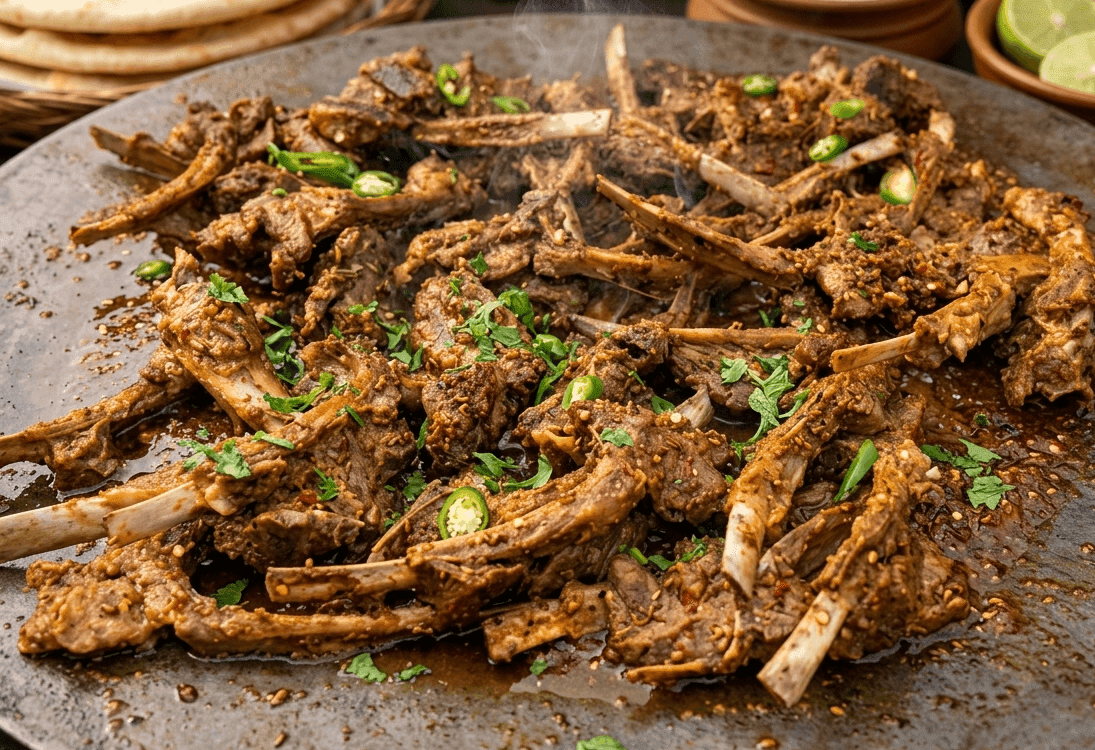
Cook for five to six minutes total, turning and working the chanp throughout. By the end of this stage the masala should be dark, thick, and clinging tightly to every surface of every chop.
The whole dried chilli pieces in the coarse ground masala will be visible as dark red flecks against the meat.
Oil from the ghee and the rendered fat should be separating slightly at the edges of the tawa. Turn the flame off.
Scatter julienne-cut fresh ginger generously over the chanp directly on the tawa. The ginger goes on right at the end, not during cooking, so its fresh sharp flavour stays bright against the rich, deeply cooked masala.
Chef's Tip:
After forty-five minutes of the first cook and thirty minutes of marinating, the meat is very tender and the bone connections are fragile. Use a wide flat spatula rather than tongs where possible, and support the full chop when you turn it rather than grabbing it by one end. A chanp that breaks during bhunai is still delicious but it loses the visual appeal that is half the point of this dish.
Why the Same Tawa for Every Stage
The most unusual thing about this recipe, and the thing that distinguishes it most clearly from other tawa chanp recipes, is that one tawa uses from start to finish. The chanp are tendered on it, cooled on it, marinated and then bhunoed on it, and served from it. This is not laziness. It is technique.
Every time the chanp cook on that tawa, they leave something behind. Rendered fat. Spice residue. Meat juices. The evaporation of all the water over forty-five minutes concentrates these things into a layer on the tawa surface. When the chanp come back for the bhunai, they are cooking on that concentrated layer, picking up everything that was left behind in the first stage and adding it to the marinade that is caramelising in the second stage. Nothing is wasted. Nothing is lost. The same tawa carries the full flavour history of the dish from the first ghee drop to the final plate.
This is exactly how dhaba and street food cooks work in Pakistan. They never clean the tawa between batches. Each new batch cooks on the residue of the last. The tawa improves with use. Chef Rizwan has brought that commercial kitchen thinking into a home recipe, and it is the single most important reason this chanp tastes the way it does.
Nutritions
Per one mutton chop
People Also Ask
Technically yes, but the pressure cooker will tender the chanp faster, around 4 whistles, but you will lose the slow fat rendering and the concentrated flavour that builds on the tawa surface during the forty-five minute first cook. If you use a pressure cooker, transfer the chanp to a tawa for the bhunai stage and accept that the first layer of tawa flavour will be thinner. The result will still be good but it will not be quite the same dish.
Yes. The dry roasted and coarsely ground whole spice masala can be made up to two weeks ahead and stored in an airtight container. The mixed yogurt marinade, however, should be made fresh on the day because yogurt begins to separate and the ground spices begin to absorb moisture from the yogurt over time, losing their coarse texture. Make the dry masala ahead, mix it with the yogurt on the day of cooking.
It means the first cook made them too tender, past the ninety to ninety-five percent mark Chef Rizwan specifies. The chanp are still perfectly edible and will taste exactly the same. To prevent this next time, reduce the first cook time by five minutes and check earlier. Every piece of mutton is slightly different in thickness and fat content, so the exact time will vary. Some chanp need thirty-five minutes, some need forty-five. Check them at thirty-five and go by feel rather than strictly by the clock.
Yes. Lamb chops work in this recipe. Reduce the first covered cook time to twenty-five to thirty minutes since lamb is younger and more tender than mutton and will reach the ninety to ninety-five percent mark faster. All the masala quantities, the marinade, and the bhunai stage remain exactly the same. Lamb chanp will have a slightly milder flavour than mutton but the masala is strong enough that the difference is small.